

Structuring O-Level Situational Writing for Higher Marks
Situational writing is an important component of the GCE O-Level English examination. Unlike creative writing, it assesses how effectively students communicate information in practical situations, whether they are writing an email, letter, report, article, or speech.
However, understanding the O-Level situational writing format involves more than memorising how each type of writing begins and ends. Students must interpret the question, identify their intended audience, address every task requirement, and maintain an appropriate tone throughout their response.
From a tutor’s perspective, one common challenge is that students may have good language skills but struggle to apply them to the specific demands of situational writing. At Blue Herring Academy, we help students overcome this by teaching them to analyse tasks, organise ideas, and structure their responses effectively.
—
—
Key Takeaways
- Understanding the O-Level situational writing format helps students select the appropriate conventions for emails, letters, reports, articles, and speeches.
- Situational writing carries 30 marks, with 10 marks for task fulfilment and 20 marks for language.
- Before planning a response, identify the writer’s role, intended audience, purpose, and required content.
- Effective writing develops each task point with relevant explanations and supporting details.
- Structured practice, targeted feedback, and careful review can help students recognise weaknesses and strengthen their examination techniques.
—
—
Understanding the O-Level Situational Writing
Before students can improve their writing, they need to understand what the examination expects them to demonstrate. The O-Level situational writing format combines practical communication skills with specific task requirements, making it different from open-ended composition writing.
—
What Is the GCE O-Level Situational Writing?
Situational writing is a functional writing task that requires students to respond to a given scenario using an appropriate O-Level situational writing format, audience awareness, and language register.
Within the O-Level English Paper 1 writing section, students may be asked to produce an email, letter, report, article, or speech. The question typically provides a situation, instructions, and supporting materials that students must interpret.
Unlike creative storytelling, where students develop an original narrative, situational writing requires them to communicate information for a defined purpose. For example, students may need to recommend a school programme, write an appreciation letter, or deliver a persuasive speech.
Each situation requires different decisions about tone, organisation, and supporting details. When teaching the O-Level situational writing format, we encourage students to identify three elements before drafting:
- Audience: Who will read or hear the message?
- Purpose: What should the response achieve?
- Context: What circumstances influence the information and tone?
A student writing to a principal should generally adopt a more formal register than someone writing to an aunt. However, both responses must communicate their intended messages clearly. Recognising these differences helps students avoid treating every situational writing task as a standard essay.
—
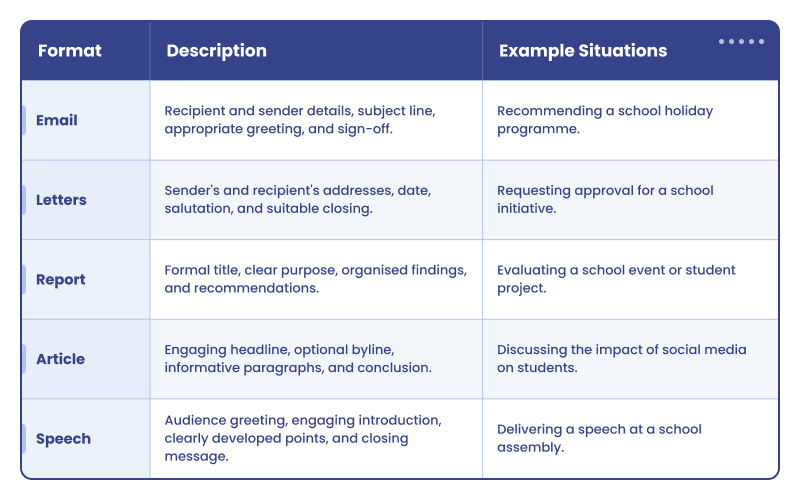
What Are the Common O-Level Situational Writing Formats Tested?
Students may encounter different writing formats, each with its own conventions. When teaching the situational writing exam format, we emphasise understanding each task’s purpose and audience.

We remind students that the distinction between formal and informal writing formats extends beyond greetings. Word choice, sentence construction, and the way ideas are presented must remain appropriate throughout the response.
Typical structure:
- Sender’s and recipient’s email addresses
- Subject line
- Salutation: Use an appropriate greeting, such as Dear Sir/Madam, Dear Principal Tan, or Dear Aunt Beth (informal).
- Greeting: How are you? (*applicable only for informal)
- Introduction: Establish the writer’s role where relevant and clearly state the purpose of writing (e.g. As President of the Student Council, I would like to…).
- Body paragraphs
- Closing
Example situations:
- Recommending a one-week school holiday programme for your cohort.
- Thanking an aunt for sponsoring a holiday trip.
- Expressing interest in an internship and highlighting relevant qualifications.
Our tutors’ advice: Students sometimes include lengthy greetings in formal emails, delaying the main purpose of their message. For example, when writing to a principal to request approval for a school activity, students should state their purpose early rather than begin with several sentences of small talk. This helps maintain an appropriate tone and keeps the response focused.
—
Letter
Like emails, letters may be formal or informal depending on the audience and purpose, but they follow traditional letter-writing conventions. We guide students to identify whether a letter is formal or informal before choosing an appropriate salutation.
Typical structure:
- Sender’s address and date
- Recipient’s address
- Salutation
- Body paragraphs addressing each task point
- Polite closing and signature
Example situations:
- Requesting approval for a school initiative.
- Writing to a relative to express appreciation.
- Providing feedback to an organisation.
Our tutors’ advice: We remind students that formal letters should remain respectful and purposeful, while informal letters can be more conversational. However, both must address the task requirements clearly.
—
Report
Reports are used to present factual information, evaluate situations, and make recommendations. Unlike personal correspondence, reports generally require an objective tone and a clear progression of ideas.
Typical structure:
- Title
- Recipient details
- Introduction explaining the purpose
- Sections organised under headings (optional)
- Conclusion or recommendation
Example situations:
- Reporting on a school programme.
- Evaluating a community project.
Our tutors’ advice: Students sometimes describe activities without evaluating their relevance. We teach them to connect their observations and recommendations to the report’s objectives, explaining why particular findings or suggestions matter.
—
Article
Articles are written for a broader audience, such as readers of a school newsletter or website. They should be informative and engaging while maintaining a clear focus on the assigned topic.
Typical structure:
- Engaging headline
- Byline to include author’s name
- Introduction to capture attention
- Sub-headlines are optional
- Body paragraphs developing the topic
- Concluding statement
Example situations:
- Writing about a student initiative
- Discussing the impact of social media on students
- Promoting a holiday tour package to potential travellers.
Our tutors’ advice: An engaging introduction should serve the article’s purpose rather than simply sound impressive. We encourage students to consider what their readers would find relevant and develop the article around those interests.
—
Speech
Speeches are written to be delivered aloud to a specific audience. They require direct audience engagement, a clear message, and language appropriate to the occasion.
Typical structure:
- Speech title including venue, date and time of speech
- Greetings to the audience
- Introduction explaining the topic
- Main points organised clearly
- Closing message or call to action
Example situations:
- Speaking at a school assembly
- Presenting an idea to fellow students
Our tutors’ advice: Memorising the O-Level situational writing format is useful, but students must also recognise when individual conventions are appropriate. The question’s instructions should always take priority over a generic template.
Ultimately, mastering the O-Level situational writing format requires students to understand both structural conventions and how to apply them in practice. Our tutors emphasise that the correct format provides a foundation, but relevant content, an appropriate tone, and purposeful explanations make a response effective.
—
What Are the Key Skills Being Assessed?
Situational writing carries 30 marks, comprising 10 marks for content and task fulfilment and 20 marks for language.
This distribution highlights why students need to balance complete responses with clear, accurate expression. Following the correct O-Level situational writing format alone is insufficient if the content is underdeveloped or the language is unsuitable.
—
Understanding Audience and Purpose
Students must recognise the task context to ensure their writing communicates the intended message effectively. They should identify:
- Who they are writing to
- Why they are writing
- What message needs to be communicated
—
Addressing Task Requirements
Students must follow all instructions carefully, ensuring that every required point is addressed with relevant information and sufficient explanation.
—
Organisation of Ideas
Students should present their ideas in a clear, logical sequence, using well-structured paragraphs to help readers follow their message.
—
Tone and Register
Students must adapt their language to suit the intended audience and purpose, maintaining an appropriate formal or informal tone throughout.
—
Language Accuracy
Students must communicate their ideas accurately and clearly. Their writing is assessed based on:
- Grammar
- Sentence structure
- Clarity of expression
When reviewing student work, we look beyond isolated grammatical mistakes.
For example, a student may write grammatically accurate paragraphs but fail to explain why a recommended activity benefits the intended audience. This weakens task fulfilment even when the language is technically correct.
Similarly, a response may include every required point but lose effectiveness through unclear organisation or inconsistent tone. Understanding these assessment areas helps students see the O-Level situational writing format as a communication task rather than simply a formatting exercise.
—
—
Scoring Well in Situational Writing
Scoring well requires students to make deliberate decisions before and during writing. In our approach, we emphasise accurate question interpretation, purposeful paragraph development, and reviewing whether the completed response achieves its intended purpose.
The following sections explain how students can apply the O-Level situational writing format more effectively under examination conditions.
—
What Are the Task Instructions?
The task instructions establish what students must write, whom they are addressing, and which information they need to include. Misreading even one instruction can affect the response’s relevance and completeness. We teach students to examine the question systematically before developing their ideas.
—
Identify the Key Elements
Students should first determine whether they are writing as a student, committee member, school leader, or another assigned role. They should then identify the recipient and the intended outcome.
For example, a student council president proposing an activity to a teacher should provide clear justifications and use language appropriate to the audience and purpose.
—
Address Every Required Bullet Point
Task prompts commonly contain bullet points specifying what students must cover. Students should identify each requirement and ensure it is addressed in the response.
A common issue is combining several points into one paragraph without developing them adequately. Although the student may mention every requirement, the explanation can remain superficial. We recommend treating each bullet point as a content obligation, then deciding how to organise related points logically.
—
Study Supporting Materials
Questions may include posters, announcements, schedules, email extracts, or programme descriptions. These materials often contain details necessary for an accurate response.
For example, when recommending a holiday programme, students may need to refer to its duration, activities, and target participants. We teach students to identify essential details from the supporting materials and develop relevant explanations in their own words to meet the situational writing task requirements.
—
What Is the Standard Structure for Situational Writing?
Although each O-Level situational writing format has its own conventions, we teach students to follow a clear progression: establish the purpose, address the required points, develop supporting explanations, and conclude appropriately. Our approach to O-Level situational writing structure emphasises organising ideas logically while adapting the response to the specific task and audience.
—
Opening Section
The opening should establish the purpose of the writing without unnecessary background information. Depending on the format, students may begin with a speech greeting, an email explaining why they are writing, or a report introduction outlining its objective.
Examples:
- greeting the audience in a speech
- opening an email with a clear reason for writing
- introducing the aim of a report
—
Addressing Task Points
Each required point should be developed through a clear explanation supported by relevant details. We encourage students to avoid simply listing recommendations.
For example, instead of writing, “Students should attend a cooking course because it is useful,” they could explain how the course builds meal-preparation skills, independence, and confidence in everyday situations. The second approach demonstrates stronger reasoning and greater relevance to the proposed programme.
—
Using Supporting Details
Students should incorporate relevant information from the task materials to strengthen their explanations. We encourage them to:
- Avoid copying directly from the prompt
- Paraphrase key information in their own words
- Use ‘what’, ‘why’, and ‘how’ questions to develop ideas with meaningful explanations and supporting details.
—
Closing Section
The conclusion should reinforce the writing’s purpose and suit the chosen format. Depending on the format, the conclusion may include:
- a polite sign-off in a letter or email
- a summarising statement in a report
- a closing message in a speech
The conclusion should reinforce the writing’s purpose and suit the chosen format. An email may end with a polite request and sign-off, while a report may summarise its recommendation.

Situational Writing Format Example: A School Programme Report
The following example demonstrates how to apply the O-Level situational writing format to a report. It shows how students can make a clear recommendation, justify their choice, and propose activities that support the programme’s objectives.
Examination Scenario (Hypothetical)
As President of the Student Council, your Teacher-in-Charge has tasked you to suggest a one-week course for Upper Secondary students as part of acquiring life skills beyond classroom learning. The course will be held at the start of the June school holidays.
In your report, you should:
- recommend one of the three courses and explain why this course is the most
- ideal
- state a possible activity outlined in the course that students can participate in
- recommend another activity not outlined in the course that students can
- participate in
- explain what students can learn from these activities and why they will find them enjoyable
Report On One-Week Course For Upper Secondary Students:
Ms Shirley Tan
Teacher-in-Charge
Student Council Committee
Date: 13 March 2026
Subject: Recommendation Report for Upper Secondary One-Week Course
1. Opening Section
The purpose of this report is to summarise and recommend possible activities for the one-week course and evaluate the programme’s impact on students’ learning.
2. Addressing Task Points
Purpose of the Course
The one-week course for Upper Secondary students aims to encourage learning beyond the classroom while having fun. It also provides opportunities to acquire skills and values, and to unwind after an intense period of studying.
Available Courses
Students are to select one of the three available courses, each designed to focus on either enhancing mental focus, building physical strength, or improving social interaction and class cohesion.
Students’ Responses
Overall, the programme should be carefully designed to achieve its intended objectives. Feedback from previous participants indicates that the activities offer a valuable respite from academic routines while exposing students to learning beyond the confines of textbooks.
3. Using Supporting Details
Based on research findings, activities that place less emphasis on academic pursuits and more on experiential learning allow students to develop values and skills more effectively than simply acquiring factual knowledge from textbooks.
4. Closing Section
In conclusion, the one-week course during the June school holidays would be a meaningful initiative for students after an intensive period of academic study. We sincerely hope that you would give us approval to proceed with the necessary arrangements.
Thank you for your kind attention.
For better understanding, please refer to this sample report.
—
Tutor’s Perspective on the Example:
This report demonstrates how students can address all four task requirements through clear, relevant explanations. It recommends the Culinary Skills Course, justifies its suitability, identifies an existing cooking activity, and proposes a meal-planning challenge.
More importantly, each activity is linked to specific learning outcomes and reasons students may find it enjoyable. When teaching the O-Level situational writing format, we use examples like this to show students how to develop complete responses rather than simply mentioning the required points.
—
How to Plan Before Writing
Students sometimes begin drafting immediately because they are concerned about completing the examination on time. However, writing without a clear plan can lead to missing points, repeated ideas, and unnecessary corrections. We encourage students to spend a few minutes preparing a focused outline before writing.
—
Step 1: Analyse the Task
Identify the required O-Level situational writing format, intended audience, writer’s role, and purpose. For example, if the question asks students to persuade a principal to approve an activity, the response must contain convincing reasons rather than a purely descriptive account.
—
Step 2: Organise Ideas
Assign the required bullet points to suitable paragraphs and decide which supporting details to include. A useful situational writing planning strategy is to create a brief paragraph map showing each main idea and its explanation. This reduces the likelihood of developing one point extensively while neglecting another.
—
Step 3: Decide the Tone
Consider the relationship between the writer and recipient. A formal proposal should sound respectful and professional, while a personal letter may adopt a warmer, more conversational tone.
Students should maintain this register consistently rather than switching styles midway through the response. We teach the O-Level situational writing format alongside these planning habits so students learn to make appropriate decisions independently.
—
How to Score Well in Situational Writing
Strong situational writing requires a clear understanding of the task and the ability to communicate ideas effectively, rather than relying on complex vocabulary or lengthy responses.
As an English tuition centre in Singapore, we emphasise five practical situational writing exam techniques to help students strengthen their writing skills.
—
Understand the Task Clearly
Read the scenario carefully and identify the required outcome before drafting. Students should be able to explain, in one sentence, what their response needs to accomplish.
—
Follow the Correct Format
Use the conventions appropriate to the assigned task. A speech should address its audience, while a report should present information in an organised, objective manner.
—
Use All Given Information
Incorporate relevant details from the bullet points and supporting materials. However, students should avoid inserting every available detail without considering its relevance.
—
Maintain the Correct Tone
Choose language that reflects the audience and purpose. For instance, persuasive writing to a school authority should remain respectful even when presenting strong recommendations.
—
Write Clearly and Concisely
Prioritise precise explanations over unnecessarily sophisticated vocabulary. A straightforward sentence that communicates a relevant point effectively is often more useful than a complicated sentence that obscures the meaning.
With regular practice, students can become more confident applying the O-Level situational writing format without relying too heavily on memorised phrases.
—
Common Situational Writing Mistakes and How Our Tutors Address Them
Even students familiar with the O-Level situational writing format may lose marks due to overlooked instructions, insufficient explanations, or inappropriate language. At Blue Herring Academy, we help students identify these recurring mistakes and develop practical strategies to address them.
- Using the wrong format: Students may miss key conventions. We teach them to identify the correct format, audience, and purpose.
- Missing task requirements: Students may overlook important points. We guide them to plan and address every requirement.
- Copying without elaboration: Students may repeat information without explanation. We teach them to paraphrase and develop relevant ideas.
- Inappropriate tone and poor organisation: Students may use unsuitable language or unclear structures. We help them maintain the correct register and organise ideas logically.
—
How Structured Tuition Strengthens Situational Writing Skills
Understanding writing techniques is only the beginning. Students also need opportunities to apply them, recognise their mistakes, and refine their responses under examination conditions.
At Blue Herring Academy, our syllabus-aligned English tuition in Singapore provides structured guidance through three key approaches:
- Focused examination preparation: Our O-Level English tutors guide students through task analysis, writing conventions, and time management using relevant examination exercises.
- Personalised feedback: Through O-Level English tuition, students receive guidance on content development, language accuracy, and organisation, helping them understand where improvements are needed.
- Guided practice: We offer small group English tuition and personalised learning arrangements that allow students to practise writing techniques and receive targeted support.
With consistent practice and feedback, students can develop a clearer understanding of examination expectations and greater confidence in applying their writing skills.
—
—
Frequently Asked Questions
1. How can students improve their situational writing skills?
Students can improve by practising different formats, analysing examination questions, and reviewing their responses against task requirements. Understanding the O-Level situational writing format is important, but students should also practise developing explanations, selecting relevant supporting details, and maintaining an appropriate tone. Targeted feedback helps identify recurring weaknesses that independent practice may not reveal.
2. Why is situational writing important in the O-Level English exam?
Situational writing assesses students’ ability to communicate effectively in practical contexts. It requires them to interpret instructions, organise ideas, and adapt their language to different audiences. These skills matter beyond exams because they support everyday communication, including formal correspondence, reports, proposals, and presentations.
3. How do you identify the correct format for situational writing?
Students should examine the task instructions to identify their assigned role, intended audience, and purpose. The question will usually indicate the required writing type, such as an email, report, article, or speech. Once identified, students should apply the appropriate conventions while ensuring their content addresses every required point.
—
—
Conclusion
Mastering the O-Level situational writing format requires students to interpret task instructions, develop relevant explanations, and adapt their language to different audiences.
With structured practice and targeted feedback, students can strengthen their writing skills and approach examinations with greater confidence. For parents considering English tuition in Hougang, choosing a programme that addresses their child’s specific writing challenges can provide the focused support they need for O-Level preparation.
—
—
About Blue Herring Academy
Blue Herring Academy is a specialised English tuition centre in Singapore, offering small class sizes and syllabus-aligned lessons. Through personalised guidance and targeted feedback, our tutors help students overcome writing challenges and prepare effectively for national examinations.
Contact us to develop greater confidence in approaching situational writing.